ABOUT US

Located in the historic Pike Place Market, Isadora’s has specialized in exquisite antique jewelry for 38 years. Our discriminating collection includes pieces from the early 1800’s through the 1950’s, without a reproduction to be found. Our precious pieces are sent to North American Gem Lab for independent appraisals. We invite you to call our toll free number for applicable discounts. On many of our pieces, we are able to offer between 10-25% off of appraisal value.
Showing posts with label egyptian. Show all posts

Saturday, December 3, 2011

The Dance of the Butterfly: Beautiful Butterfly Gifts


We have the absolute best butterfly jewelry at the moment. Here are a select few pretties. 
Enjoy.


Beautiful Butterfly Holiday Gifts.

Monday, August 1, 2011

Summer: A Time for Travel

Summer is always a fun time in Isadora’s.  Thousands of people visit the historic Pike Place Market each May through September, many of them taking a moment, a half an hour or even a half a day to pop into our store, and enjoy our collection. 

Seattle Pike Place Market
We so enjoy hearing each individual’s story as pass through our store and lives, enriching us with a greater sense of the people of this world we live in.  And sometimes those of us who work in the store get a chance to take a trip ourselves.

Tourism is not a new thing.  On my very favorite movies and novels (It is so rare I like both) is “A Room with a View” by E.M. Forster where the young Lucy Honeychurch is transformed by a trip to Italy during the early 20th century.

Mt. Vesuvius Ash Cameo Brooch

I feel, the good vacations we eagerly anticipate, thoroughly enjoy, and hold as a memory for years to come.  The great vacations transform us.  And so I ask myself, how do we hold those memories after we leave, retain the beauty and the emotional sustenance they provide having returned to our normal life once again? 

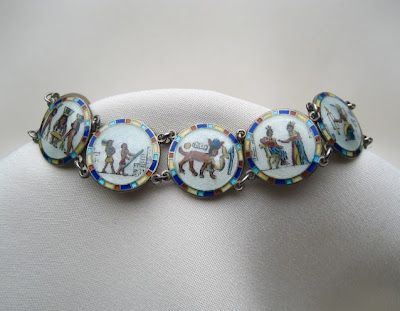
Egyptian Revival Bracelet
I remember a quote from the movie Rebecca (another book/movie although I confess I never made it to the book after being captivated by Laurence Olivier’s Maxim de Winters).  Joan Fontaine’s character says, “You know, I , I wish there could be an invention . . . that bottled up the memory like perfume.  And it never faded, never got stale.  That whenever I wanted to, I could uncork the bottle and live the memory all over again.”

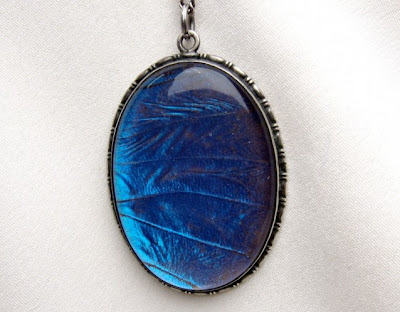
1920's Butterfly Wing Necklace
And I suppose one can’t truly live a memory again, but like Joan Fontaine’s imagined bottle, I believe an object can be the keeper for a memory.  You look at it and remember the smell of your vacation, the excitement, the transcendent moments.  And for me jewelry has always been a perfect memory holder.  It is something personal, so personal it is worn on your person and whether it is a ring on your finger or a locket on your neck you hold the memories close when you put that piece of jewelry on.

Vintage Italian Themed Charm Bracelet
And just as I love to look at my souvenir’s brought back from different parts of the world, I also like to look at what others chose to collect on trips aboard.  Particularly the tourists of yester year-whether it is an Italian cameo purchased on a Victorian lady’s grand tour, a piece of Egyptian revival enamel jewelry inspired by the opening of King Tut’s tomb, a British butterfly wing pendant sold at the British Empire Exhibition of 1924 or a sweet 50’s silver charm bracelet collected by a young girl as she traveled the world.  

Friday, April 1, 2011

EGYPTIAN FASHION AND THE SCARAB RING

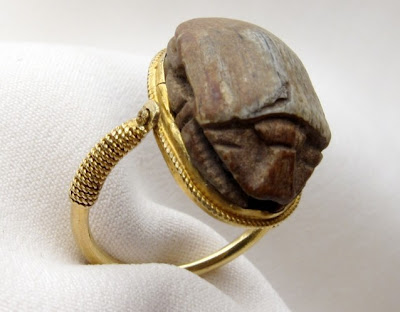
This December I received a fantastic ceramic scarab ring for Christmas. 
         What is a scarab ring you might ask?  Well until a couple years ago I did not know either.  But now that I know I am obsessed. 
         Popular since ancient Egypt, scarab jewelry is jewelry set with either stones carved to look like the scarabaied beetle or in the Victorian era pieces, often set with actual beetle carpasces or exoskeletons. 
         I have always been a person who is inexplicably drawn to things, whether it is art, jewelry, clothing or people.  And that was how I felt about scarab jewelry.  From the first moment I espied an 1890's Victorian, scarab brooch I was in love. 
         But now that I have a piece of my own, I decided to do a little more research and find out exactly what else has fascinated people about the scarab from Ancient Egypt to the present.
         In ancient Egypt the scarabaied beetle was considered a divine symbol of rebirth for it represented the ancient deity, "Kheprie" who each day rolled the sun, "Ra", across the sky transforming bodies and soles.  And thus the scarab became the earthly symbol of the heavenly cycle.
         And so ancient Egyptians wore scarab charms, amulets and beads on necklaces and rings for good luck, protection, bravery and fertility.
         A dynamic symbol or charm the scarab beetle was also considered the protector of the written word.  They would use the smooth stomach of the carved scarab as a tablet on which to engrave.  For instance, Amehotep the III was famous for using scarabs commemoratively.  Using scarabs he memorialized the great lion hunts and the story of how he built a lake for his wife Queen Tiye.
         And the most important scarab of all, to the ancient Egyptians, was the "heart scarab" which was buried with the dead to ensure their rebirth in the afterlife.
         Of course, the popularity of the scarab did not end in ancient Egypt as my ring attests.  As with many Egyptian motifs the scarab was very popular in Victorian England as it was in the 1920's when King Tut's tomb was excavated.  Like in ancient Egypt you could find fabulous scarabs, carved out of precious stones.


But you could also find scarab jewelry with the true exoskeleton of an iridescent beetle.  Like the wings found in butterfly jewelry the beetles were usually brought from South America. 


These more realistic scarab pieces are difficult to find but truly spectacular to see.  As in most things it is hard to outdo nature's beauty and the iridescent blacks and greens of the beetles exskeleton is a wonderment to see. 

Now as I look at the ring, nestled on my right hand, I see not only the beauty of a piece in singularity but I see a ring set against a backdrop of symbol and fashion and I love it even more.  


Sunday, March 21, 2010

Egyptomania

Egyptomania is the expression best to describe my fascination with Egyptian art and culture as its influenced artists over thousands of years.

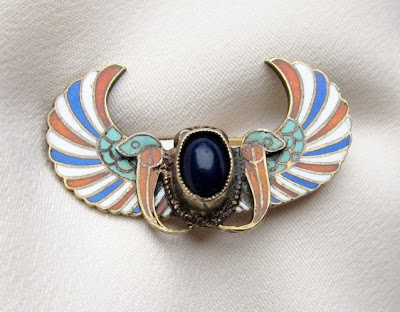
In 1922 the unearthing of King Tut was made and with this a new appreciation for Egyptian art and design was discovered. With an emphasis on the discovery of King Tut in the Art Deco period we saw a surplus of strong examples of how artists used Egyptian decorative motifs to their own advantage and applied them within the popular jewelry of the time. Emerging styles included scarabs along with Etruscan Revival techniques so popular during the Victorian era. As well as pendants of King Tut in his coffin.

The motifs were not always used in their most pure form and were stylized in the artists own interpretation. Some so clearly enamel scenes using Egyptian using figures you may see on the wall of a temple or a tomb in the Valley of the Kings. Yet some so diluted that the motifs were barely recognizable as Egyptian, none the less producing wonderful pieces.