ABOUT US

Located in the historic Pike Place Market, Isadora’s has specialized in exquisite antique jewelry for 38 years. Our discriminating collection includes pieces from the early 1800’s through the 1950’s, without a reproduction to be found. Our precious pieces are sent to North American Gem Lab for independent appraisals. We invite you to call our toll free number for applicable discounts. On many of our pieces, we are able to offer between 10-25% off of appraisal value.
Showing posts with label art deco. Show all posts

Wednesday, August 3, 2011

Louise Brooks: Fashion Icon

Louise Brooks was an American dancer, model, actress and show girl from the late 20s early 30s. The style Brooks exhibited was like no one else. The dynamism of her style screams give me a cocktail, a cocktail ring of course.


Friday, April 8, 2011

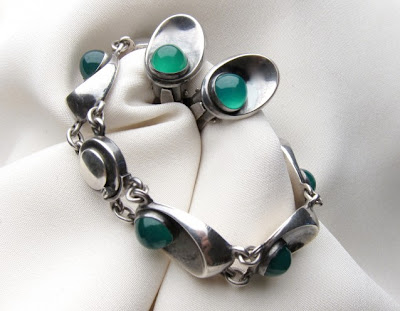
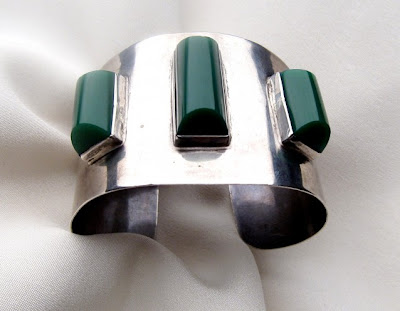
CHRYSOPHRASE: The Other Green Stone

In the store I often get questions about the stone chrysophrase so I thought I would write a blog. 

Often mistaken for jade, chrysophrase is a beautiful opalescent green color and is part of the same rare quartz family chalcedony, as onyx, agate & carnelian.  It gets it beautiful green color from nickel and it rates a 7 on the Mohs scale.

         Like many of my favorite gemstones it has a long history.  The word "chrysophrase" comes from the Greek "Chryso" meaning gold and the root word "Prasinon" meaning green.  And the ancient Greeks and Romans used chrysophrase to make beautiful cameos and intaglios. 
         Chrysophrase can also be found in the decoration and jewelry of the Ancient Pharaohs.  And in ancient China it was believed to balance the Yin and Yang, while in India it was believed to heal a broken heart.
         One of its heydays was during the Middle Ages when it was mined in Silesia, in what is now Northern Czech Republic and Southern Poland.  So loved was this stone it was mined to exhaustion in Silesia although it can be now found on other continents.  One of its greatest consumers was Prussian King Frederick the Great who was born in 1712 and ruled from 1740-1786.  A patron of Bach and a friend with Voltaire, he was also was an enormous fan of chyrsophrase, using it to adorn his palace in Potsdam.
         Another enormous fan of chrysophrase was the famous Peter Carl Fabrage who featured it in many of his exotic pieces.

         In our store I am drawn to chrysophrase pieces used in Arts and Crafts jewelry and pieces from the Art Deco era where its distinctive apple green color gives beauty to every piece it touches.         


-Miko

Friday, December 3, 2010

CHRISTMAS COMES TO ISADORA’S. . .


For the last few months we have been making a list and checking it twice and filling our store with beautiful baubles and gems fit for the Holidays.
This holiday season, owner Laura Dalesandro and her daughter, manager Elizabeth Schoebleber have been meeting with dealers the world over to make sure the store is filled and bursting with exquisite antique pieces from the 1840’s through the 1950’s.
A couple of my personal favorites include a long Victorian watch chain made out of gunmetal, a fantastic Art Deco star sapphire ring and a pair of the prettiest circa 1840’s gold dangle earrings I’ve seen.


And they did not forget about the men this Holiday season. Just a couple of accessories for men include-- circa 1940's watches, a cigar clipper and a pair of enamel Georg Jensen cufflinks.

Sunday, March 21, 2010

Egyptomania

Egyptomania is the expression best to describe my fascination with Egyptian art and culture as its influenced artists over thousands of years.

In 1922 the unearthing of King Tut was made and with this a new appreciation for Egyptian art and design was discovered. With an emphasis on the discovery of King Tut in the Art Deco period we saw a surplus of strong examples of how artists used Egyptian decorative motifs to their own advantage and applied them within the popular jewelry of the time. Emerging styles included scarabs along with Etruscan Revival techniques so popular during the Victorian era. As well as pendants of King Tut in his coffin.

The motifs were not always used in their most pure form and were stylized in the artists own interpretation. Some so clearly enamel scenes using Egyptian using figures you may see on the wall of a temple or a tomb in the Valley of the Kings. Yet some so diluted that the motifs were barely recognizable as Egyptian, none the less producing wonderful pieces.