ABOUT US

Located in the historic Pike Place Market, Isadora’s has specialized in exquisite antique jewelry for 38 years. Our discriminating collection includes pieces from the early 1800’s through the 1950’s, without a reproduction to be found. Our precious pieces are sent to North American Gem Lab for independent appraisals. We invite you to call our toll free number for applicable discounts. On many of our pieces, we are able to offer between 10-25% off of appraisal value.

Friday, April 15, 2011

Isadora’s Plays with Vintage Clothing

Isadora’s owner, Laura Dalesandro, is dipping her toes back into the vintage clothing business. 
There was a collective grown among both homegrown vintage clothing aficionados and those on the national level when Isadora’s, a Seattle boutique specializing in Vintage Clothing and Antique Jewelry for the past thirty-eight years decided to close up shop on the vintage clothing part of the business in order to truly focus on the jewelry.
            And don’t get me wrong, there were also cheers because in focusing on the jewelry, Isadora’s tripled their inventory of the most fantastic and delightful baubles from the last 150 years.
But there were many that had an aching heart for the vintage clothing of yore.
            Well do not fear, owner Laura Dalesandro, with forty plus years buying experience, is teaming up with vintage clothing website Camellia to bring the most exquisite and exotic vintage clothing to the web. 
            Not only does owner, Laura, have her own hidden cache of vintage clothing (I’ve seen it and it is embarrassing to say clothing made me breathless but it made me breathless.)  She also will recommence buying.
            So if you have a piece of beautiful vintage clothing that you are ready to part with and want it to go to someone who will truly appreciate it, please contact Laura Dalesandro, through Isadora’s at 1-888-472-3672 or e-mail Isadora’s at info@isadoras.com.
            And if you are someone interested in buying vintage clothing or just looking at pretty pretty things, please continue to follow our blog.  We will let you know the second the clothing collection is available on Camellia’s website. 
I know I can’t wait to see what finds are displayed to delight and awe.


Friday, April 8, 2011

CHRYSOPHRASE: The Other Green Stone

In the store I often get questions about the stone chrysophrase so I thought I would write a blog. 

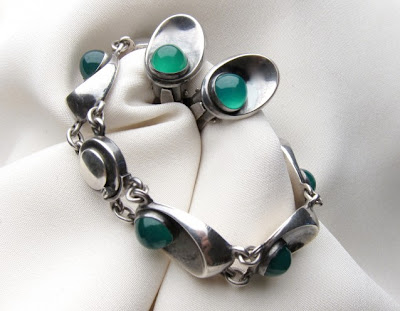
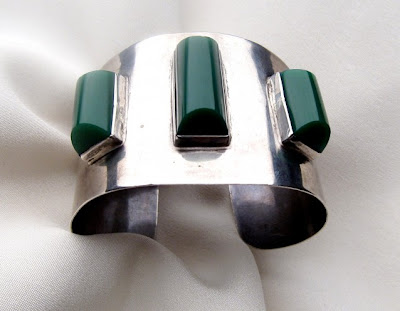
Often mistaken for jade, chrysophrase is a beautiful opalescent green color and is part of the same rare quartz family chalcedony, as onyx, agate & carnelian.  It gets it beautiful green color from nickel and it rates a 7 on the Mohs scale.

         Like many of my favorite gemstones it has a long history.  The word "chrysophrase" comes from the Greek "Chryso" meaning gold and the root word "Prasinon" meaning green.  And the ancient Greeks and Romans used chrysophrase to make beautiful cameos and intaglios. 
         Chrysophrase can also be found in the decoration and jewelry of the Ancient Pharaohs.  And in ancient China it was believed to balance the Yin and Yang, while in India it was believed to heal a broken heart.
         One of its heydays was during the Middle Ages when it was mined in Silesia, in what is now Northern Czech Republic and Southern Poland.  So loved was this stone it was mined to exhaustion in Silesia although it can be now found on other continents.  One of its greatest consumers was Prussian King Frederick the Great who was born in 1712 and ruled from 1740-1786.  A patron of Bach and a friend with Voltaire, he was also was an enormous fan of chyrsophrase, using it to adorn his palace in Potsdam.
         Another enormous fan of chrysophrase was the famous Peter Carl Fabrage who featured it in many of his exotic pieces.

         In our store I am drawn to chrysophrase pieces used in Arts and Crafts jewelry and pieces from the Art Deco era where its distinctive apple green color gives beauty to every piece it touches.         


-Miko

Friday, April 1, 2011

EGYPTIAN FASHION AND THE SCARAB RING

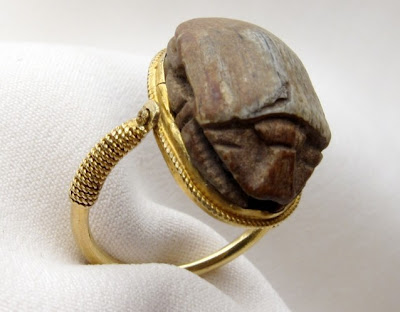
This December I received a fantastic ceramic scarab ring for Christmas. 
         What is a scarab ring you might ask?  Well until a couple years ago I did not know either.  But now that I know I am obsessed. 
         Popular since ancient Egypt, scarab jewelry is jewelry set with either stones carved to look like the scarabaied beetle or in the Victorian era pieces, often set with actual beetle carpasces or exoskeletons. 
         I have always been a person who is inexplicably drawn to things, whether it is art, jewelry, clothing or people.  And that was how I felt about scarab jewelry.  From the first moment I espied an 1890's Victorian, scarab brooch I was in love. 
         But now that I have a piece of my own, I decided to do a little more research and find out exactly what else has fascinated people about the scarab from Ancient Egypt to the present.
         In ancient Egypt the scarabaied beetle was considered a divine symbol of rebirth for it represented the ancient deity, "Kheprie" who each day rolled the sun, "Ra", across the sky transforming bodies and soles.  And thus the scarab became the earthly symbol of the heavenly cycle.
         And so ancient Egyptians wore scarab charms, amulets and beads on necklaces and rings for good luck, protection, bravery and fertility.
         A dynamic symbol or charm the scarab beetle was also considered the protector of the written word.  They would use the smooth stomach of the carved scarab as a tablet on which to engrave.  For instance, Amehotep the III was famous for using scarabs commemoratively.  Using scarabs he memorialized the great lion hunts and the story of how he built a lake for his wife Queen Tiye.
         And the most important scarab of all, to the ancient Egyptians, was the "heart scarab" which was buried with the dead to ensure their rebirth in the afterlife.
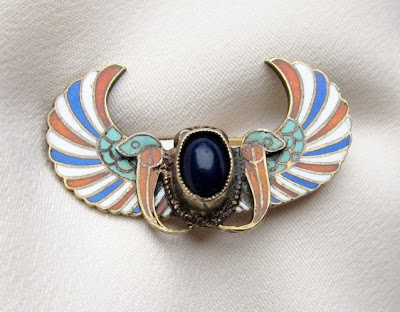
         Of course, the popularity of the scarab did not end in ancient Egypt as my ring attests.  As with many Egyptian motifs the scarab was very popular in Victorian England as it was in the 1920's when King Tut's tomb was excavated.  Like in ancient Egypt you could find fabulous scarabs, carved out of precious stones.


But you could also find scarab jewelry with the true exoskeleton of an iridescent beetle.  Like the wings found in butterfly jewelry the beetles were usually brought from South America. 


These more realistic scarab pieces are difficult to find but truly spectacular to see.  As in most things it is hard to outdo nature's beauty and the iridescent blacks and greens of the beetles exskeleton is a wonderment to see. 

Now as I look at the ring, nestled on my right hand, I see not only the beauty of a piece in singularity but I see a ring set against a backdrop of symbol and fashion and I love it even more.  


Friday, March 18, 2011

THE MAGIC OF MOONSTONES

         As noted in a previous blog posting, we’ve just received a number of new pieces from one of our favorite European dealers.  And as we frantically work to get all these gorgeous baubles posted to our website I find my eye re-returning to three moonstones pieces—one a large cabochon cut moonstone ring, one a moonstone pendant and one an Arts & Crafts moonstone necklace with a stunning blue cast.


         I have always had a fascination with moonstones.  And really who wouldn’t?  Moonstones have a mystical name--moonstone.  Which is probably why the Victorian author, Willkie Collins named his popular Gothic mystery novel “The Moonstone”.  Although after investing my money in a copy of this novel I was sorry to find out it was a mystery centering on a diamond, named the moonstone.  I wanted to know why it wasn’t a moonstone named a moonstone and was very put out. As a result of his duplicity, I have yet to read said novel although I have heard it was very good.  But really why did he mislead me?
Anyway inspired by these three pieces I decide to explore the myths and legends surrounding the real moonstone.


         It is a diamond in the rough so to speak, a rarity among common rocks.  It is a member of the feldspar family, which composes 2/3 of all the rocks in the entire world.  But unlike its sister rocks it is very rare and extraordinarily beautiful. 
         Where does the beauty come from I ask.  A lot of it comes from a quality called "adularisation" which is an exquisite shimmer that is caused by the lamella inner construction of the gemstone causing incident light rays to refract and scatter in the stone.  Which is all to say that this fantastic, almost transparent stone has a wonderful shimmer and sheen as light plays across its surface and from within.  It is a thing that cannot really be described but must be seen.
         The moonstone was named by the Romans, who believed, it had the ability to reflect light.  In India they believed it was a sacred stone, holy and magical and they believed it could bring the wearer beautiful visions.
         Other ancients believed if you held it in your mouth you could tell the future and others still believe you could see in it the crescent and waning phases of the moon.


         It has also been said at various times to bring good fortune, to protect women and children who are generally under the protection of the moon, enhance passion, balance yin and yang and strengthen emotional and subconscious aspects, our intuition and our capacity to understand.
         It is also said to be the lover's stone because it evokes tender feelings and safeguards the true joys of love.
         All of these layers of meaning are fantastic but I cannot get over the most fantastic thing of all and that is the visual beauty of the moonstone.  It is a beauty that fascinated the famous Art Nouveau French Master Lalique who featured it prominently in many of his most beautiful pieces. 
         And it is a beauty that has fascinated people for countless centuries as each generation discovered a new way to set, wear and enjoy these fantastic pieces.


Click here to see our other Moonstones


Featured in Q & A

We were just featured in a Q & A by the Examiner. Check it out!

Part One 
Part Two

Thank you again Sandra. It is always so nice to do interviews like this.

Sunday, March 6, 2011

New Arrivals! from our European Dealer

This last week we met with one of our fantastic European dealers and oh boy did we get some goodies. About 90 pieces all ranging from the alluring 1850's turquoise earrings (you see below), to the clever designs of the Art Deco era. And of course bangles! Some of the most captivating silver Victorian cuffs I've ever scene. 

Currently, we're trying to get all of these lovelies up on the website, but in the mean time you should come by and have a look for yourself.


 (Turquoise and 18kt gold earrings)

(Art Deco diamond and sapphire ring)

Friday, February 4, 2011

Amethyst: February's Birthstone


Bacchus had grown angry with mortals and had therefore
determined that tigers would devour the next mortal who
crossed his path. The young maiden Amethyst was on
her way to worship at the goddess Diana’s temple. Diana
knowing Bacchus’s plan turned the young maiden into a
white statue of colorless quartz to save her. When Bacchus
realized what he had precipitated he was filled with remorse
and cried tears of wine, staining the statue a beautiful purple.


The origin myth of the amethyst is beautiful and tragic
like so many Greek legends. It is easy to paint a picture in
your mind of the beautiful white quartz dappled with purple
tears until it becomes the exquisite stone we know today as
amethyst and my jewelry obsessed mind begins to wonder—
what shade of purple did those tears create. Were there
only a few tears, creating a pale lilac statue, the stone
sometimes termed ‘the Rose of France’ or were his tears
plentiful producing a deep purple amethyst with red flashes?
It is February, and February is the month of amethysts
in the jewelry world so I decided to explore the myths and
legends surrounding this stunning stone.


A quartz, it rates a 7 on the Mohs scale and has color

ranging from the palest lilac to the deepest purple. A royal
color it has often been worn by the clergy and royalty and it
can be seen in the crown jewels of both Britain and Russia.
And today most amethysts can be found in Brazil.

This incredibly beautiful stone has wooed warriors,
intellectuals and great monarchs. It is said the ancient
Egyptians brought an amethyst stone into battle for
protection, that Leonardo da Vinci considered the amethyst
the seat of intelligence and a means of warding of evil and
that Catherine the Great prized the amethyst above all other
stones.

Everyone has his or her own personal relationship to a
stone, whether it is a fascination founded on a stone being
assigned ones birthstone or the moment when one espies
the perfect ring. My fascination began with a perfect 1950’s
cocktail ring with an amethyst stone that can be called
nothing short of charismatic. I look at it today and wonder
what began Catherine the Great’s fascination or Leonardo
da Vinci’s and it gives me pleasure to know that while the
world moves forward there are some things that maintain
their beauty and fascination from ancient Greece through my
own personal history.