ABOUT US

Located in the historic Pike Place Market, Isadora’s has specialized in exquisite antique jewelry for 38 years. Our discriminating collection includes pieces from the early 1800’s through the 1950’s, without a reproduction to be found. Our precious pieces are sent to North American Gem Lab for independent appraisals. We invite you to call our toll free number for applicable discounts. On many of our pieces, we are able to offer between 10-25% off of appraisal value.

Monday, November 14, 2011

Isadora’s Returns From a Buying Trip!!!


We at Isadora’s love, love, love the holidays.  We’re celebration kind of people and we particularly love Christmas, which is why we have been searching the world over for the oldest, the most beautiful and the most exotic jewelry we can imagine for your holiday gift giving needs.

Beautiful Vintage Amber Screw back Earrings
And we are pretty darn proud of what we have found, whether it is:

Mid 20th Century Turquoise & Diamond Cocktail Ring

 or

Vintage Enamel Snake Necklace (With Matching Bracelet)

 or 

1920's Old European Cut Diamond Ring
We have it!  We are also excited to unveil our new collection of vintage jewelry from Japan, India and the Golden Triangle.

Spiral Bracelet: In the Golden Triangle, where this bracelet was made, the spiral is know to represent "the repetitive rhythms of life and the being's permanence over the transience of change."

Please stop by soon or sooner to see what we have, as each pieces is one of a kind and there may be only one chance to see these fantastic vintage and antique jewelry finds.  

Friday, November 4, 2011

Citrines: A Golden Birthstone

It is a new month and therefore I get to research and think about a new, fabulous and beautiful birthstone.  And this month it is the citrine, one of my personal favorites.

Edwardian Citrine Heart & Crown Earrings

The citrine is named after the French word “citrin” meaning lemon.  And it will always hold a special place in my heart and on my hand because my very first Isadora’s piece of jewelry was a fantastic whiskey colored 1950’s citrine cocktail ring, a gift from Isadora’s owner. I wear it regularly to this day.

Citrine Cocktail Ring 

There is not much legend attached to the citrine but there doesn’t need to be.  The beauty of the stone speaks for itself.  Sometimes a lemony yellow color and at other times a warm, whiskey hue, it is a stone complex and inviting. 
           
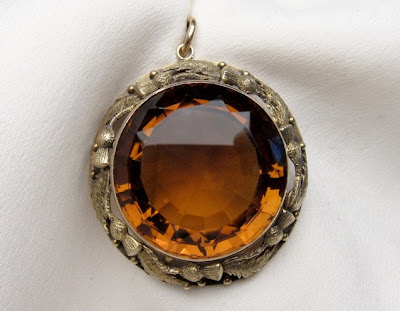
Victorian Citrine Pendant Necklace

We all have our own connections to stones and to the visual world in general but for me the citrine is a stone that feels simultaneously comfortable and sexy   There is something so natural and warm about the stones golden color and yet it still has that fire and sparkle that makes it oh so much more.

To see more fantastic antique citrine pieces please follow this link: Isadora's Antique Citrine

Tuesday, October 25, 2011

California’s Tourmaline Rush

In my monthly search to uncover the secrets of October’s birthstones I learned a little nugget of information that surprised and intrigued me.  Apparently the Gold Rush was not the only precious metal/gemstone to create a craze in the hills of California.  Between 1898 and 1914, San Diego County California outdid Brazil, Burma and Ceylon when it came to the production of Tourmalines as the world; particularly China became crazy for California Pink Tourmalines.

Pink Tourmaline 
It began when Gemologist J.L. Tannenbaum, having seen a beautiful piece of pink  tourmaline from California, decided he needed to have more of this fantastic stone.  So posing as a consumptive looking to buy a mountain cabin among the healing air of California he scouted and purchased the Himalayan Mine.  He proceeded to mine a prodigious amount of these beautiful stones.

The Dowager Empress of China, Tzu Hsi
His chief purchaser was the dowager empress of China, Tzu Hsi, who could not get enough of California’s pink tourmaline, making it the de jour stone for the wealthy of China, where it was used not only in jewelry but in fantastic ornately carved snuff bottles, some of which can be seen in museums today.

Carved Pink Tourmaline Snuff Bottle
The empress loved tourmaline so much that on her death and burial she decided her eternal rest would be on a tourmaline pillow.

Isadora's Art Deco Pink Tourmaline Ring
Brazil today, is the leading producer of tourmaline but the California mines continue to mine beautiful tourmalines and they are still most famous for pink tourmalines in all different shades and hues.  And if you buy a vintage or antique pink tourmaline piece there is a good chance it came from the Himalayan Mine.

-MIKO

Wednesday, October 19, 2011

Retro!!!

All I want for Fall is a little bit Retro... or lets be real a lot.


Why not be fabulous while watching the falling leaves.

Monday, October 17, 2011

The Tourmaline – A Stone of Incredibly Dynamic Color

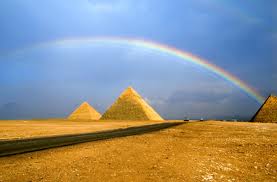
An Egyptian legend holds that on the tourmaline’s journey from the center of the earth it passed across a rainbow and the stone was therefore gifted with all the rainbow's beautiful colors.

A rainbow arching over the pyramids
And yes, a tourmaline stone can represent each color of the rainbow, but that does not even come close to describing the multitude of colors that tourmalines can come in.  The range of colors represented by tourmalines makes the jumbo pack of crayons look monochromatic it is so varied and dynamic.  

Beautiful Cabochon Cut Tourmalines
Tourmalines fuel my interest in color because they, more than anything I’ve ever encountered, surprise me with colors unexpected and new.  Every time I think I have a color figured out and find myself making a blanket statement like, “I don’t’ like pink”, a tourmaline will come into our store to refute my statement. 

A Stunning Pink Tourmaline Ring 
For instance there were two rings that changed my views on pink.  One was a Victorian ring centered by a tourmaline, pink with undertones of coral giving it an idiosyncratic, exotic and stunning beauty.  Another was an Art Deco pink tourmaline ring that I loved for its depth of color.  One client called it a smoky pink because the pink had almost a charcoal color layered underneath the pink, which sounds odd but was exquisite.  It was as if pink had become a liquid like the ocean with all the depth and nuance of the sea’s color.  Which is all to say, I now no longer say I don’t like pink because the tourmaline sure makes pink look sexy.  It makes pink looks sexy as it does red, orange, yellow, green, blue and all the colors you thought you knew until the tourmaline made you take a closer look.


I tried to learn more about how the tourmaline creates such dynamic color and I learned a little but there was a lot of technical language, which I’ll admit I zoned out on.  But what I did absorb had to do with the fact that the crystals that actually make up the stone, unlike most stones crystals, can be multi colored themselves so the very building blocks of the stone lend itself to dynamic colors.  And also tourmalines are unusual in that many of them change color depending on the light and angle.


Regardless of the why or wherefore, tourmalines are one of natures greatest beauties and it is not surprising that the tourmalines root words “tura mali” is the Singhalese words for ‘stone with mixed colors’.  It is also not surprising that the tourmaline in addition to being one of October’s birthstones is also the stone of artists, authors, actors and those in creative fields because that much variety can be nothing but inspiring.


Wednesday, October 12, 2011

The Extreme Fragility of Opals: A Myth Debunked


Being an October baby, opals have always fascinated me and I was very fortunate to receive several at a young age.  The most special being a three stone opal ring that belonged to my great grandmother Lucille.
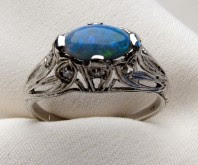
Art Deco Opal Filigree Ring
When I received it my grandmother gave me a talk about the fragility of opals and how I must care for this ring not only as a piece that was once my great grandmother's and therefore warranted extra attention but also as a piece of jewelry that was extremely delicate and could not be banged around or even immersed in water.  And as a conscientious child and a rule follower, I did as she said, wearing it only on special occasions and taking it off when I washed my hands.  But now I work in a jewelry store and I realize I owe it not only to myself but I also owe it to my clients to look closer into what is fact and what is fiction when it comes to the fragility of the opal.

Opal rates a 5.5 to 6.5 on the Moh's scale.  The Moh's scale was a scale created in 1812 to characterize the hardness of various stones.  It ranges from 1 to 10 with 1 being the softest, the softness of talc and 10 being the hardest, the hardness of a diamond.

Uncut Opal

So what exactly is a 5.5 to 6.5 on this scale? Well, to give some every day hardness analogies, a penny is a 3, a knife blade is a 5, a glass window is a 5.5 and a steel file is a 6.5.  So while not the hardest thing on earth, an opal is pretty darn sturdy.  Much sturdier than my grandmother lead me to believe.

Still there was that warning about immersing my ring in water?  My grandmother told me never to wash my hands while wearing my opal ring and I diligently did not do so.  Well I have since learned this was over conscientious and unnecessary on my part.  Apparently an opal is non-porous and therefore does not absorb any water.  Water has a neutral effect on opals.  Although they may look extra pretty while immersed.  So where does this rumor about not getting your opals wet come from?  It comes from the fact that many stones sold as opals at one time were actually doublets or triplets, which are composite stones.  A jeweler has glued several layers of opal to a black backing to appear like one single stone.  These composite opals when wet may loose their adhesion and therefore fall apart but a true opal will have no repercussions from water.

Edwardian Opal & Diamond Ring

But what about those people who say the opposite; that you must immerse your stones in water every so often or they will crack?  Again a myth taken belief.  A very low percentage of stones have a very low water content when they are formed and therefore are likely to crack.  But an opal goes through a lot of crackable situations before they are ever set into a piece of jewelry and therefore the fragile ones are weeded out when the stone is mined, transported or cut.  A vintage or antique stone that has been set in jewelry for 50, 75 or 100 years has already proven it is not one of these stones time and time again.

The only danger I discovered is extreme temperature.  So if you were thinking of setting your opal over a flame you might want to reconsider but I doubt that is the case.  And very very low humidity for an extended period of time may hurt your stone but barring that you can feel comfortable wearing your stone.  I plan to wear mine.