ABOUT US

Located in the historic Pike Place Market, Isadora’s has specialized in exquisite antique jewelry for 38 years. Our discriminating collection includes pieces from the early 1800’s through the 1950’s, without a reproduction to be found. Our precious pieces are sent to North American Gem Lab for independent appraisals. We invite you to call our toll free number for applicable discounts. On many of our pieces, we are able to offer between 10-25% off of appraisal value.

Sunday, May 15, 2011

THE BEAUTY OF CARNELIAN


One of my favorite stones is carnelian.  Like onyx, agate and chrysophrase it is a member of the quartz: chalcedony family and it has a color ranging from a vibrant orange to a deep rust red.  Its name comes from the Latin root "Caro" or "Carnis" meaning flesh.  Which can be attributed to the flesh color sometimes exhibited by this beautiful stone.

         Archeologist have found carnelian pieces dating as far back as 1800 BC, recovering it from the Bronze Age Minoan layers at Knossos on Crete.
         Popular in many eras, the Romans believed it signified courage and popularly used it for signets or seal rings as wax does not stick to it.  (When you touch carnelian it has a slippery finish that is very distinctive to the touch.)
         In ancient Egypt they placed carnelian stones on their mummies as they believed it would assist in journeying to the afterlife and there were carnelian stones in King Tutenkahamen's mask, discovered in the 1920's.
         The Babylonians and Greeks believed it meant "Good Luck".

Monday, May 2, 2011

Mother's Day and the Beautiful Sentimentality of Heirloom Jewelry

I like “Mother’s Day”.  There is something beautiful about a holiday centered on thanking someone for all the wonderful things they do and for essentially giving one the gift of life.  And because mother’s day puts me in a sentimental mood today I am going to write about a sentimental style of jewelry – the locket.


When I think of lockets I always think of my great grandmother.  I never saw her without one of two lockets around her neck.  When I was born she wore a clear locket with a photograph of me in it.  Three years later when my brother was born she alternated a locket with my photograph and a locket with my brother’s photograph, which I can tell you was a bone of contention for quite some time.  Now at the mature age of thirty I wonder if at some point there was a third locket of my father that we ousted upon our births. 


But what I do know is, I walked proud when my great grandmother had my photo strung round her neck so everyone could see.  And when I was little I thought everyone wore clear lockets so people could see the photograph within.  But as with everything we learn more as we age and a magical vista of beautiful and different lockets was introduced to me.


So today I decided to learn a little more about lockets. 

According to my research the first locket can be traced back to William the Conqueror and 1050BC.  At that point in history a locket housed not a picture but poison, powder or snuff and was at that time called a “Loquat” (Old English for small latch or lock).

It was in 1679 that the locket became popular as a device to hold a memento, often a lock of a loved ones hair.  (It is even said the term “Lock of Hair” comes from the Victorian tradition of snipping a curl of hair from a loved one and placing it in a locket).


It was not until the 17th Century that the locket began to hold a picture like it most frequently does today.  At that era in pre-photographic historic time it would have been a small painted portrait often given to a loved one as a memento on the commencement of a journey or a place for a woman to keep an image of her children.

And then in 1860 we get closer to modern tradition with the advent of the miniature photograph.


Jewelry is a very personal thing.  We wear it close to us and while our jeans and sweater might change with the shifting season and even faster shifting styles, our jewelry, the pieces we love we wear for a lifetime and the stuff we really love is worn for generations. 


I am lucky I come from a family that loves jewelry and values passing it down from generation to generation, finding a connection between mother, daughter, grandmother and great grandmother.  I have four generations of women’s jewelry in my jewelry box and often on my person.  I have my great grandmother’s Victorian brooch given to her in Montana by my great grandfather.  I never met my great grandmother Aya but I have a connection in that piece of jewelry that she passed down to my grandmother and she in turn passed down to me.  I have my great grandmother Lucille’s opal ring because we were both October Birthdays and she felt it was important that that piece be passed down to someone with a like Birthday.  I have my grandmother’s engagement ring from her second marriage and I have my mother’s favorite earrings from her college years, a pair of hoops bought on a memory filled trip to Morocco.  I do not wear these pieces every day but every time I put them on I think about that mother.


And lockets, to my mind, seem one of the most personal pieces of jewelry of all.  In my readings I read that the heart locket came into popularity during the Victorian era because is represented another’s heart resting on one’s own and that it held a woman’s feelings for the man, woman or child pictured within.

Heirloom jewelry is such a beautiful, tangible thing, connecting one to those one loves, not only for one generation but also for many.  Jewelry like family can be multi-generational, a sentimental love story between grandmother, mother and child.

to see more Isadora's lockets please check go to this link: Locket !

Sunday, May 1, 2011

Isadora's Returns From Buying Trip with Exquisite Antique Jewels


Wondering where the women of Isadora’s were last weekend—Shopping.  Laura Dalesandro and manager, Elizabeth Schoenleber skipped town last weekend to shop, shop, shop. 


They went on a buying trip, bringing back some of the most jaw dropping beautiful antique pieces.  Their cache includes a Georgian purple sapphire ring, Victorian citrines, a Fleur de lis bracelet, seed pearl tassel earrings, diamond engagement rings and a stunning pink/peach tourmaline ring.  (I’m personally lusting after a pair of onyx and black enamel Victorian dangle earrings that extend almost from ear to shoulder.)
There is no way to encapsulate in a paragraph or two all the fantastic jewels that were purchased for the store this past weekend.  You will have to see them for yourself.
We invite you to drop by and take a peek.  Can’t make it in?--We will have all the pieces up on our website within the coming weeks.
We look forward to seeing you!!!

Friday, April 22, 2011

“The One That Got Away”

In my other life, I direct plays for the theatre and the show I just directed is entitled “The One That Got Away”.   It is about the man or woman in our life that we broke up with or parted with but are never able to let go of in our heart of hearts.
            This may make me odd but I have many more “The One That Got Away” moments with pieces of jewelry than with people.  Maybe I am more decisive when it comes to jewelry or maybe I have a stronger affinity for jewelry than people but whatever the reason I have a little photo book of “The Jewelry That Got Away” in my head (and saved on my hard drive.)
            And it is not just I; I hear it from our clients all the time.  They wax poetical about the piece of jewelry they let slip through their fingers because like with most antiques once it is sold it is gone.  There is no back stock of ring item xxy so there is almost never a second chance once a piece is sold.  And while you might find something similar you will never find something exactly the same, kind of like with people. 
            Is the fact that I equate jewelry with people scary?  I just feel really really passionately about jewelry.
            This fact came home to me the other day when I walked into the store to see my co-worker Mandy with a sad look on her face and a bottle of diet coke proffered in one hand.  I knew something I really really loved had sold.  We save treats only for when our very favorite pieces have sold and then we comfort each other with chocolate, diet coke and memories of said pieces of jewelry.
            My favorite Victorian silver chicken foot brooch with two lemony yellow citrine stones had sold and I thought to myself why hadn’t I purchased it.  It was among the pieces that got away that I actually could have afforded but I was being so called practical. 
And I ask myself, when do we go with practicality and when do we go with impulse. 
This is not an art I have yet mastered.
            My grandmother was excellent at it.  In general she would way each decision carefully.  It might take her three months to buy a trench coat but then once in awhile she would just know. She bought her favorite ring, a beautiful diamond band sparkling with thirteen marquise shaped diamonds in a spray across the top of her hand in less than an hour.  She saw it in the window, walked into the store, conversed with the sales person, looked at the paperwork and purchased it. She bought it in the 1970’s.  She wore it for forty years before passing it on to me.  And I am wearing it as I write this blog entry right now.  She just knew.
            Where does that art come from? 
I have three major items that I let get away and I still think about them.
1.     A beautiful Art Deco Emerald Ring with a perfectly imperfect emerald a minty green color with beautiful inclusions.
2.     An Edwardian mourning medallion with the repousse figures of mother and child.
3.     A Victorian citrine chicken foot brooch considered good luck in Italy.
And I ponder, how will I know next time, when it is a piece, that could potentially become another “The One That Got Away”.

-Miko Premo

Friday, April 15, 2011

Isadora’s Plays with Vintage Clothing

Isadora’s owner, Laura Dalesandro, is dipping her toes back into the vintage clothing business. 
There was a collective grown among both homegrown vintage clothing aficionados and those on the national level when Isadora’s, a Seattle boutique specializing in Vintage Clothing and Antique Jewelry for the past thirty-eight years decided to close up shop on the vintage clothing part of the business in order to truly focus on the jewelry.
            And don’t get me wrong, there were also cheers because in focusing on the jewelry, Isadora’s tripled their inventory of the most fantastic and delightful baubles from the last 150 years.
But there were many that had an aching heart for the vintage clothing of yore.
            Well do not fear, owner Laura Dalesandro, with forty plus years buying experience, is teaming up with vintage clothing website Camellia to bring the most exquisite and exotic vintage clothing to the web. 
            Not only does owner, Laura, have her own hidden cache of vintage clothing (I’ve seen it and it is embarrassing to say clothing made me breathless but it made me breathless.)  She also will recommence buying.
            So if you have a piece of beautiful vintage clothing that you are ready to part with and want it to go to someone who will truly appreciate it, please contact Laura Dalesandro, through Isadora’s at 1-888-472-3672 or e-mail Isadora’s at info@isadoras.com.
            And if you are someone interested in buying vintage clothing or just looking at pretty pretty things, please continue to follow our blog.  We will let you know the second the clothing collection is available on Camellia’s website. 
I know I can’t wait to see what finds are displayed to delight and awe.


Friday, April 8, 2011

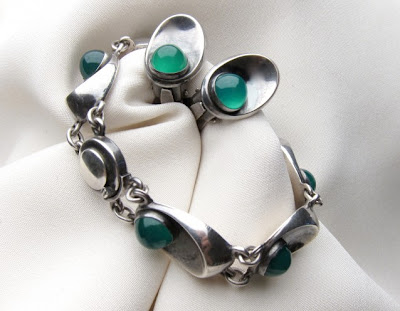
CHRYSOPHRASE: The Other Green Stone

In the store I often get questions about the stone chrysophrase so I thought I would write a blog. 

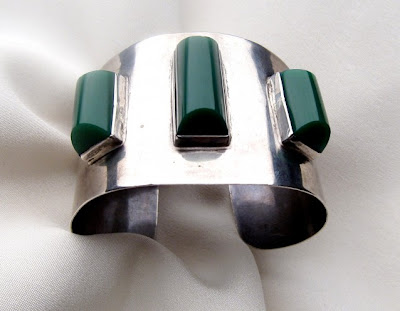
Often mistaken for jade, chrysophrase is a beautiful opalescent green color and is part of the same rare quartz family chalcedony, as onyx, agate & carnelian.  It gets it beautiful green color from nickel and it rates a 7 on the Mohs scale.

         Like many of my favorite gemstones it has a long history.  The word "chrysophrase" comes from the Greek "Chryso" meaning gold and the root word "Prasinon" meaning green.  And the ancient Greeks and Romans used chrysophrase to make beautiful cameos and intaglios. 
         Chrysophrase can also be found in the decoration and jewelry of the Ancient Pharaohs.  And in ancient China it was believed to balance the Yin and Yang, while in India it was believed to heal a broken heart.
         One of its heydays was during the Middle Ages when it was mined in Silesia, in what is now Northern Czech Republic and Southern Poland.  So loved was this stone it was mined to exhaustion in Silesia although it can be now found on other continents.  One of its greatest consumers was Prussian King Frederick the Great who was born in 1712 and ruled from 1740-1786.  A patron of Bach and a friend with Voltaire, he was also was an enormous fan of chyrsophrase, using it to adorn his palace in Potsdam.
         Another enormous fan of chrysophrase was the famous Peter Carl Fabrage who featured it in many of his exotic pieces.

         In our store I am drawn to chrysophrase pieces used in Arts and Crafts jewelry and pieces from the Art Deco era where its distinctive apple green color gives beauty to every piece it touches.         


-Miko

Friday, April 1, 2011

EGYPTIAN FASHION AND THE SCARAB RING

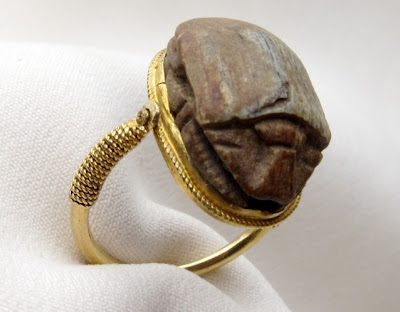
This December I received a fantastic ceramic scarab ring for Christmas. 
         What is a scarab ring you might ask?  Well until a couple years ago I did not know either.  But now that I know I am obsessed. 
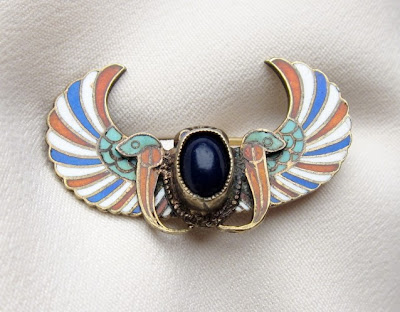
         Popular since ancient Egypt, scarab jewelry is jewelry set with either stones carved to look like the scarabaied beetle or in the Victorian era pieces, often set with actual beetle carpasces or exoskeletons. 
         I have always been a person who is inexplicably drawn to things, whether it is art, jewelry, clothing or people.  And that was how I felt about scarab jewelry.  From the first moment I espied an 1890's Victorian, scarab brooch I was in love. 
         But now that I have a piece of my own, I decided to do a little more research and find out exactly what else has fascinated people about the scarab from Ancient Egypt to the present.
         In ancient Egypt the scarabaied beetle was considered a divine symbol of rebirth for it represented the ancient deity, "Kheprie" who each day rolled the sun, "Ra", across the sky transforming bodies and soles.  And thus the scarab became the earthly symbol of the heavenly cycle.
         And so ancient Egyptians wore scarab charms, amulets and beads on necklaces and rings for good luck, protection, bravery and fertility.
         A dynamic symbol or charm the scarab beetle was also considered the protector of the written word.  They would use the smooth stomach of the carved scarab as a tablet on which to engrave.  For instance, Amehotep the III was famous for using scarabs commemoratively.  Using scarabs he memorialized the great lion hunts and the story of how he built a lake for his wife Queen Tiye.
         And the most important scarab of all, to the ancient Egyptians, was the "heart scarab" which was buried with the dead to ensure their rebirth in the afterlife.
         Of course, the popularity of the scarab did not end in ancient Egypt as my ring attests.  As with many Egyptian motifs the scarab was very popular in Victorian England as it was in the 1920's when King Tut's tomb was excavated.  Like in ancient Egypt you could find fabulous scarabs, carved out of precious stones.


But you could also find scarab jewelry with the true exoskeleton of an iridescent beetle.  Like the wings found in butterfly jewelry the beetles were usually brought from South America. 


These more realistic scarab pieces are difficult to find but truly spectacular to see.  As in most things it is hard to outdo nature's beauty and the iridescent blacks and greens of the beetles exskeleton is a wonderment to see. 

Now as I look at the ring, nestled on my right hand, I see not only the beauty of a piece in singularity but I see a ring set against a backdrop of symbol and fashion and I love it even more.